
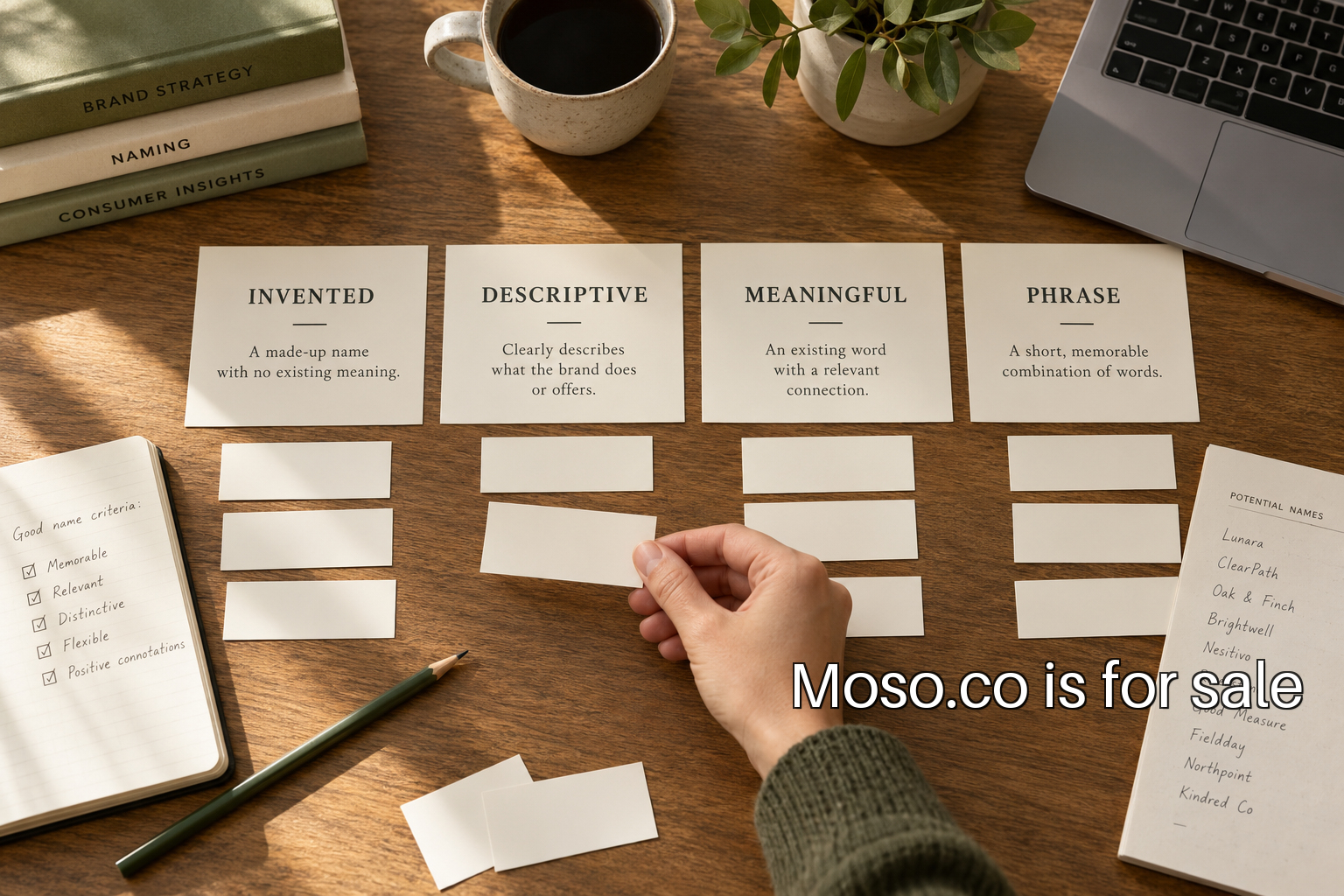
A brandable domain name is a name a business can build an identity around. It may describe the offer, suggest a quality or begin as an invented word. The useful question is what job the name will do in the business. A name used above several product lines has a different task from a name intended to describe one narrowly defined service.
That distinction matters when writing a naming brief. A shortlist can become confusing if each candidate is being judged against a different idea of the business. One person may want immediate category information; another may want room for a larger collection. Decide what the name needs to carry before deciding which candidate carries it best.
Begin with the business being named
Write a plain account of the offer as it exists at launch. Name the product or service, the people it is for and the way it will be sold. Then add the next realistic development. A company beginning with one household object may plan a broader range in the same setting. A studio may begin with one service and expect to add a related practice. Those plans give the naming brief a useful horizon.
Separate realistic development from distant possibility. A brief that tries to accommodate every future business becomes difficult to use. Focus on the work the founder is prepared to pursue and the relationships the name needs to hold. A candidate can then be assessed against the actual first offer and a plausible next step. The shortlist has a defined purpose instead of an open-ended demand to fit everything.
Descriptive names put the offer in the name
A descriptive approach uses words that identify the activity, product or audience. Its useful feature is the information it puts into the introduction. The name itself begins explaining what is available. That can suit a business with a clear category and a defined scope. The founder still needs a visual identity and an offer, but the name takes on part of the descriptive work.
Test a descriptive candidate against the next realistic offer. If the company plans to add a related service, see whether the words still fit. Decide which part of the business the description is meant to cover. It may describe the entire company, a particular service or a product line. That decision keeps a useful descriptive name from being asked to serve at the wrong level of the system.
Suggestive names leave a connection to make
A suggestive approach points toward a quality or idea rather than spelling out the full activity. The connection might concern motion, texture, care or a working method. It can give a founder a theme to develop through the product and presentation. The offer sentence then provides the practical information the name leaves open.
Write down the intended connection in plain language. If the explanation depends on a long chain of references, consider whether that chain belongs in the public introduction. A name can carry a subtle association while the business speaks directly about its work. Put the candidate beside an ordinary product description and see whether both parts feel useful together. The identity and the explanation should support the same venture.
Invented names get their context from use
An invented name begins with an open meaning. The founder gives it context through the offer, the work and the places it appears. That can be useful for a house identity with several expressions. Moso, for example, can sit above a collection, a studio practice or a shared room. The description beneath it tells a reader which of those ventures they are encountering.
Open meaning also makes the launch sentence especially useful. A visitor needs a concrete explanation of what is available. Pair the candidate with a short sentence naming the offer and audience. Then put that pair into a realistic page heading, label or proposal. You are testing a working introduction, including both the name and the words that make the first offer clear.
Separate the name from the domain's role
The business name and the domain need to be considered together because both will be used in everyday communication. Write the full domain in the brief and test it in an email address, a document footer and a spoken introduction. Record the exact spelling the business would use publicly. A naming decision becomes more concrete when the team sees the identity in the places it will actually work.
Also list the accounts, materials and documents that would carry the name at launch. This may include packaging, support correspondence, invoices and partner pages. The list is useful for planning implementation. It shows how much of the business will depend on the decision and gives a new team member a practical way to understand the intended use.
Choose criteria before showing favorites
A simple scorecard can make a shortlist discussion more productive. Include the business fit, the intended tone, the relationship to the next offer and the ability to use the name in real materials. Write a short explanation for each score. The explanation matters because it shows where people disagree about the business, rather than only where they disagree about a word.
Keep preference visible as a separate consideration. A founder will use the name repeatedly, so their willingness to say and write it matters. Put that response beside the practical criteria. A candidate can be attractive and still need a clearer role; another can fit the brief but feel wrong in the founder's own introduction. The decision improves when both responses can be discussed directly.
Run a small, realistic language test
Show each candidate in the same simple format. Use the same offer sentence, page layout and sample product so that the design treatment does not decide the result. Ask a participant to describe the offer they see and identify any spelling questions. Record their words rather than turning every response into a broad conclusion. The exercise helps locate details that need attention.
Try the name in a spoken introduction as well. Have someone read it from a page, then ask them to write what they heard. Differences can guide choices about presentation and wording. Keep the test focused on the task in front of you: whether this particular introduction is clear enough to use. It becomes one piece of evidence alongside the brief and the founder's judgment.
Finish with a one-page naming brief
The finished brief should include the launch offer, the next realistic offer, the role of the name and the desired tone. Add the places the identity will appear, the criteria for the shortlist and the decision process. Keep the candidate list separate so the brief can guide the discussion before a favorite takes over.
A brandable name becomes useful through the business built around it. The brief gives that work a starting structure. It tells the team what the identity must introduce now, how it should relate to the next offer and what materials need to carry it. With those choices written down, a founder can compare actual names for the company they intend to build.